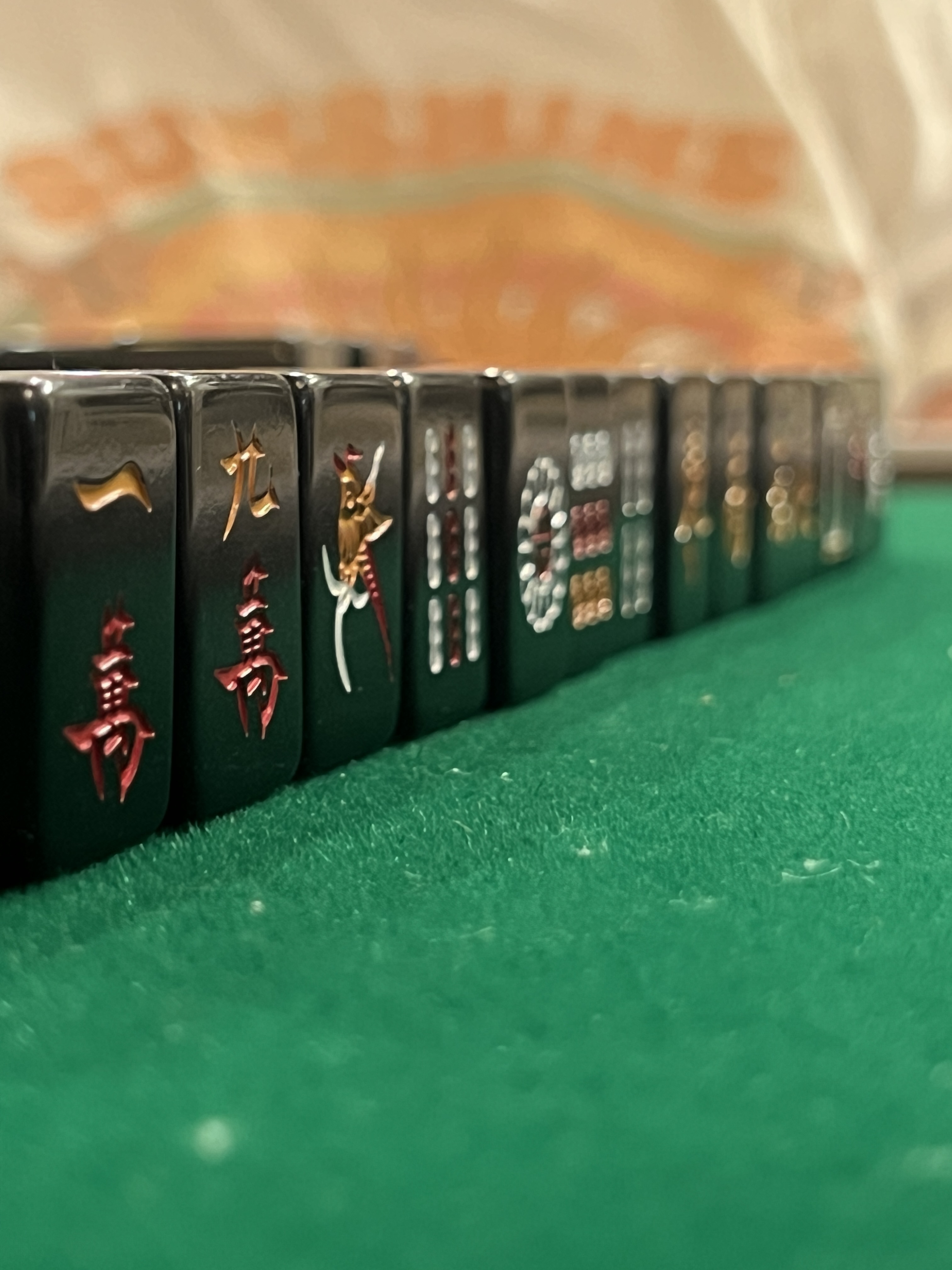
I was talking to a member of the San Diego Mahjong Club recently when he brought up a situation he encountered while teaching new players Zung Jung Mahjong. One player asked him:
“How is Zung Jung any different from Hong Kong Mahjong?”
He answered, “Well, the difference is really in the scoring.”
That answer is correct, but I don’t think it does justice to Zung Jung, as it makes the difference seem trivial. It isn’t. The difference between Zung Jung and Hong Kong Mahjong lies largely in the scoring system, but what matters more is how that scoring system affects the game. I am going to stand ten toes down and say this: Zung Jung is a better-balanced game than Hong Kong Mahjong. Let me repeat that: Zung Jung has better game balance than Hong Kong Mahjong, and the scoring system is the reason why.
Scoring Is Game Design
In mahjong, scoring isn’t merely a way of determining how much a hand is worth after somebody wins. Scoring creates the incentives players respond to while constructing their hands. Those incentives influence which strategies are worthwhile and, ultimately, how the game is played. Zung Jung’s scoring system creates balancing incentives that other mahjong systems, including Hong Kong and Riichi, sometimes need additional rules to achieve. One of the clearest examples is the use of point minimums.
Why Hong Kong Uses a Faan Minimum
Hong Kong Mahjong is often played with a minimum of 3 faan. The purpose of the minimum is straightforward: it prevents small, fast hands from dominating the game. Without sufficient incentive to pursue larger hands, mahjong can become a racing game. Players are encouraged to assemble the fastest legal hand possible rather than considering whether slowing down to pursue additional value is worthwhile.
Consider some common Hong Kong patterns. Small patterns such as All Sequences or a Dragon Triplet may be worth only 1 faan, while familiar higher-value hands such as Half Flush or All Triplets are worth 3 faan. Depending on the exact payment schedule being used, the relationship between faan and actual payments may be nonlinear. But the underlying balancing problem remains: if cheap hands are sufficiently efficient relative to larger hands, players have a strong incentive to race.
A 3-faan minimum directly addresses that problem. You simply aren’t allowed to win until your hand meets the minimum. It works. But there is a cost.
Zung Jung Takes a Different Approach
Zung Jung doesn’t solve this problem by prohibiting small hands. Instead, it changes the incentives. A Chicken Hand is worth only 1 point. Small patterns such as All Simples or All Sequences are worth 5 points—five times the value of the weakest possible winning hand. Then consider what we might call a standard “good hand.” All Triplets is worth 30 points, while Half Flush is worth 40 points. Now the difference becomes enormous.
A 30-point hand is worth 30 times as much as a Chicken Hand and six times as much as a basic 5-point pattern. A 40-point Half Flush is worth eight times as much as one of those small patterns. Zung Jung is telling the player, “You can win cheaply if you want. But are you sure you want to?” That creates a strong incentive to pursue larger hands without requiring the rules to prohibit smaller ones.
Incentives Instead of Prohibition
This is the important distinction. A point minimum balances the game through prohibition. Hands below the threshold cannot win. Zung Jung balances the same competing pressures primarily through incentives. Small hands remain legal, but valuable hands are rewarded generously enough that players have a reason to pursue them. That preserves more of the game’s decision space. A 1-point Chicken Hand is legal. A 5-point All Sequences hand is legal. A 10- or 15-point hand is legal. A 30-, 40-, or 50-point hand is legal.
The question isn’t simply:
“Am I allowed to win with this?”
The more interesting question is:
“Should I?”
Suppose you can complete a small hand quickly. Taking the win gives you points immediately and denies your opponents the opportunity to finish whatever they’re building. But perhaps your hand could become something substantially more valuable. Continuing increases your expected reward if you succeed, but it also gives your opponents more time to win first. There is no universal answer. That’s the strategic tension.
Speed or Value?
Zung Jung preserves the speed-versus-value decision across the entire range of legal winning hands. Point-minimum systems constrain the lower end of that decision space by declaring some otherwise complete mahjong hands insufficient to win. Zung Jung instead allows the player to make that decision. Sometimes the correct choice is to race. Sometimes the correct choice is to build.
Several 10- or 15-point wins in succession can add up to significant value by repeatedly shutting opponents out. At other times, accepting a tiny hand means giving up an opportunity for a 30-, 40-, or 50-point score that could substantially change the game. And because larger hands generally require more time, commitment, and risk, the player is constantly balancing probability, speed, and potential reward.
That is why saying that Zung Jung and Hong Kong Mahjong are different “because of the scoring” is technically correct but incomplete. Scoring isn’t sitting on top of the game. Scoring shapes the game. Scoring IS the game. Zung Jung’s scoring system creates a deliberate incentive structure in which virtually every complete hand remains available to the player while dramatically different rewards encourage players to consider how ambitious they should be.
Should I play this hand for speed?
Or should I play it for value?
Answering that question is one of the central strategic decisions in Zung Jung Mahjong.
Leave a Reply